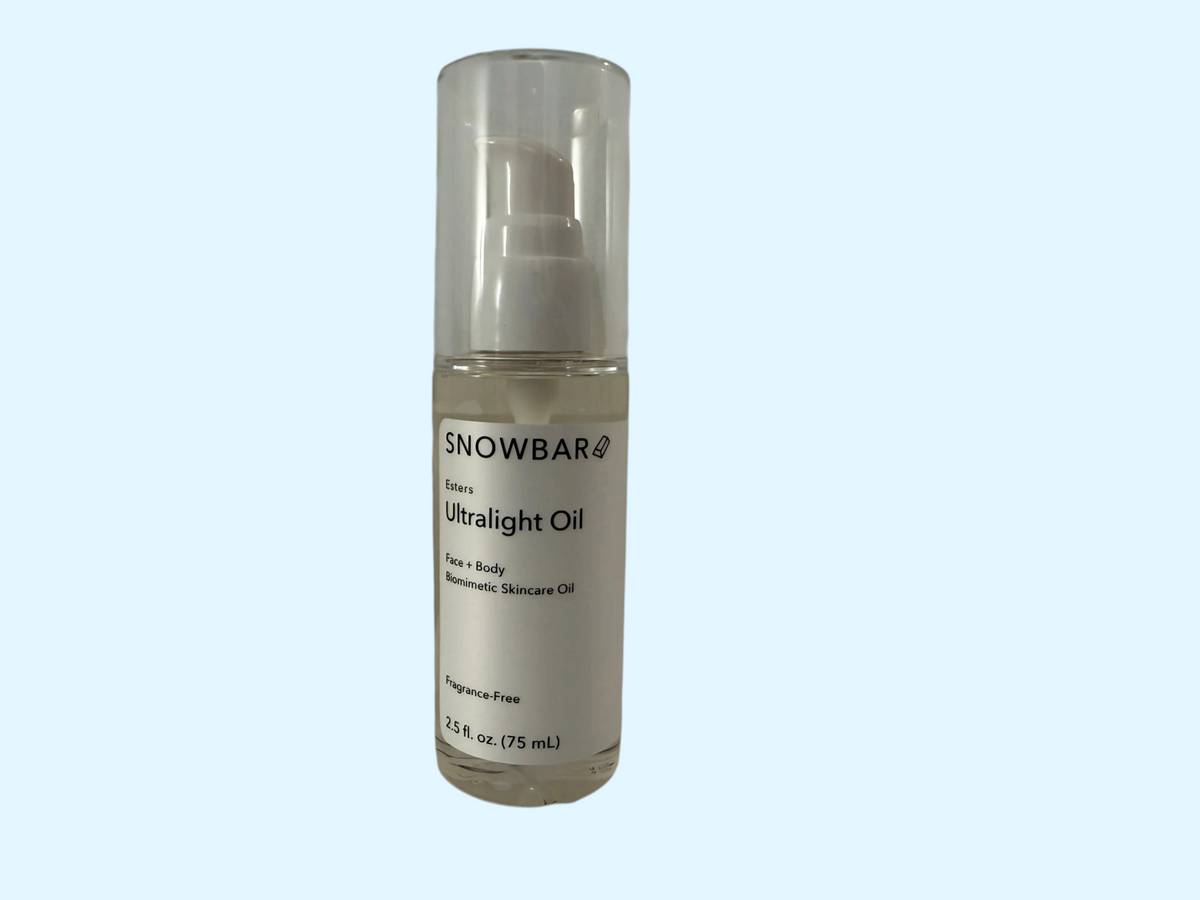
SNOWBAR
Esters
Ultralight Oil
Ultralight Oil
Couldn't load pickup availability
Share this product with your friends!
With an incredible lightweight feel that you have to experience for yourself, the Ultralight Oil is your new go-to oil for skin nourishment.
No silicones, no mineral oil, no greasy feeling
Your skin loves esters.
Esters are molecules that contain one or more ester bonds. Most oils and waxes in nature (e.g. olive oil, beeswax) are made of esters. Your body produces its own esters that help keep your skin healthy. Ultralight Oil mimics these esters to form the perfect daily skincare oil for all-over nourishment.
Ingredients:
Full List of Ingredients: Jojoba Esters, Tricaprylin, C10-30 Cholesterol/Lanosterol Esters, Tocopherol
Jojoba Esters are produced by modifying Jojoba Oil with itself. Jojoba oil is unique. Most oils found in nature are made predominantly of esters called triglycerides. Triglycerides contain 3 ester bonds. The esters in Jojoba Oil contain only 1 ester bond, which is why it is referred to as a liquid wax ester. This allows us to rearrange the esters within the Jojoba Oil to make them incredibly light-weight while still mimicking the oil structure of human-made esters.
Tricaprylin is a triglyceride ester isolated from Coconut Oil. It is very similar to the popular ingredient Caprylic/Capric Triglyceride, except it only contains the Caprylic Triglyceride for the lightest possible skin feel.
C10-30 Cholesterol/Lanosterol Esters closely mimic the cholesterol esters produced by the human body that integrate into its natural oils. This ingredient allows for intense skin nourishment while still delivering a light skin feel.
Tocopherol is an antioxidant commonly known as Vitamin E. It helps keep the formula stable. We prefer to use tocopherol as an antioxidant over BHT and TBHQ.
Directions / Instructions:
Directions: Apply a small amount to the skin and spread evenly as desired. Store product in a cool, dry, dark place.
Caution: For external use only. Do not ingest. Use only as directed. Do not add water or any other substances directly to the container. Do not use on damaged or inflamed skin. Avoid direct contact with eyes. If contact occurs, rinse thoroughly with water. If irritation occurs, discontinue use. Keep out of reach of children.
Shelf Life: 12 months
More About Esters:
Human skin relies heavily on a diverse group of naturally synthesized esters—chemical compounds formed by bonding fatty acids with alcohols or glycerol—to maintain its structural integrity, retain moisture, and protect against environmental damage. These esters originate primarily from two distinct sources: the sebaceous glands, which excrete oily sebum onto the surface, and the epidermal keratinocytes, which produce lipids during the maturation of the skin's outermost barrier, the stratum corneum.
Key Esters Produced by the Skin
- Wax Esters (Mono- and Di-esters)Wax esters are a hallmark of human skin, making up roughly 25% to 30% of human sebum. Synthesized by sebocytes, they consist of long-chain fatty acids linked directly to long-chain fatty alcohols (including specialized mono-wax esters and hydroxylated diesters). Humans are almost unique among terrestrial mammals in producing such high concentrations of wax esters on the skin surface.
- Glycerol Esters (Triglycerides & Diglycerides)Triglycerides—esters formed by binding three fatty acid chains to a glycerol backbone—comprise the largest single component of sebum (~40% to 50%). As sebum travels up through the follicular duct and onto the surface, microbial and human enzymes partially break these down into diglycerides (glycerol diesters), monoglycerides, and free fatty acids.
- Cholesteryl Esters Formed by esterifying cholesterol with long-chain fatty acids, cholesteryl esters account for a smaller percentage of skin surface lipids (~2% to 4%). They are present both in sebaceous secretions and in the lipid matrices produced during epidermal keratinization.
- Acylceramides (Esterified Ceramides)In the stratum corneum, specialized epidermal ceramides (such as Ceramide EOAH or Ceramide EOS) feature an omega-hydroxy fatty acid that is esterified to an additional fatty acid (often linoleic acid). Although ceramides are structurally classified as amides, these ester-linked side chains play a foundational role in the physical arrangement of skin barrier lipids.
Biological Importance
- Water Retention & Occlusion: Wax esters and cholesteryl esters form an extremely hydrophobic, flexible barrier on the skin surface. This coating drastically reduces transepidermal water loss (TEWL), keeping the upper layers of the epidermis hydrated and pliable in dry conditions.
- Microbiome Modulation & Acid Mantle: As triglycerides and glycerol diesters are cleaved by skin microbiota (such as Cutibacterium acnes), they release free fatty acids like sapienic acid and lauric acid. This enzymatic activity lowers the pH of the skin surface to create the "acid mantle," an acidic microenvironment that inhibits pathogenic bacteria while supporting commensal organisms.
- Structural Barrier Assembly: Acylceramides in the stratum corneum act as molecular rivets. Their long esterified fatty acid tails insert into neighboring lipid bilayers, locking the lipid matrix into tightly packed lamellar sheets that prevent harmful chemicals and microbes from penetrating the body.